At the recent Flex Day on 9 September 2025 in Christchurch, some very flex-y people shared early insights and information on their very flex-y projects. FlexForum wants to support continued sharing of thinking and activity with these and other flex-y projects, so keep an eye out for more updates.
Three of the four projects described here are happening due to EECA investing in the Scaled Demand Flexibility pilot project. This programme builds on evidence from FlexTalk proof-of-concept trials and involves five to six separate pilots, each engaging around 500 households or a commercial or industrial area. The pilots aim to demonstrate how distributors can use flexibility to defer, delay or avoid network upgrades, and how people can use flexibility to reduce their day-to-day costs of living. Flexibility will be obtained by retrofitting connectivity to existing resources such as water and space heating, and by deploying home batteries for solar-fitted homes, vehicle-to-grid EV chargers, community-level batteries, and home energy management systems.
Each project is at a different stage of development and delivery, and changes to approach and timing are likely. Some may not make it past stop/go milestones, which would be disappointing given how flex-y each is. For now, please accept these project descriptions on a best endeavours, “as is, where is” basis.
Alpine Energy described its initiative as an exploration of the potential for coordinated industrial flexibility to help manage network capacity constraints emerging in the Timaru Port and Washdyke areas. The project is currently in its discovery phase, which will run through to 2026, and this work involves carrying out flexibility audits to understand the potential of 13 industrial sites relative to network needs. From 2026 to 2029, the implementation phase will deliver solutions that emerge from this discovery work, depending on what industrial participants are able and prepared to do.
Orion Energy shared details of its project testing flexibility as an alternative to network upgrades using market arrangements that reward the network value of being flexible. The test area is a suburb with 9,000 households and 300 businesses that experiences a higher evening load and a growing 9–10pm peak. The intention is to recruit up to 1.66MW of aggregated flexible capacity from sources such as home and community batteries, EV charging, and energy management systems coordinating in-home devices like heat pumps. A key focus is to understand how people respond to live signals of network capacity constraints, as flexibility can reduce network costs in real time.

Two key insights so far from the Orion project are:
Orion is making a stop/go decision later in 2026, and a potential May 2026 launch.
Vector’s project is creating a test-bed of the future for a highly electrified, flexible network. It aims to demonstrate how real-time network capacity management can be achieved before low-voltage networks face widespread security challenges.

The Western Bay of Plenty flexibility project is developing solutions to defer transmission and distribution investments in the Tauranga and Te Matai areas.

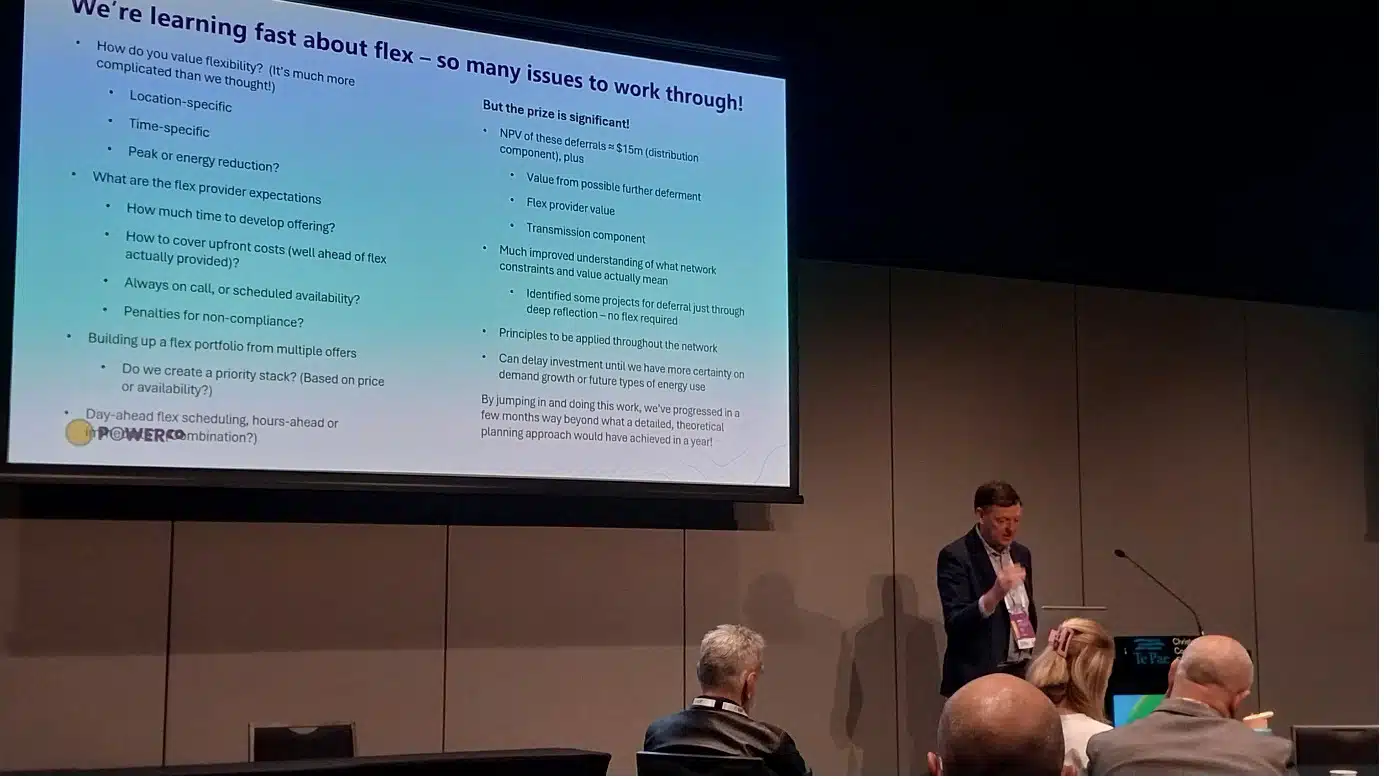
Transpower and Powerco presented their Western Bay of Plenty flexibility project, which aims to develop solutions to defer transmission and distribution investments in the Tauranga and Te Matai areas. Transpower is exploring various ways to source the flexibility it needs, including through Powerco’s LocalFlex platform, through multiple flexibility coordinators either using LocalFlex or bilaterally, and through programme design options such as product choices and performance requirements. Powerco is involved because its asset plan includes around $140 million of reinforcement spend in the same areas, which could be deferred over a two- to five-year period starting in 2027. An expression of interest process in early 2025 has already moved into the contractual phase.Insights coming from the Powerco experience so far include:
These flex-y projects are pushing the boundaries of what’s possible for flexibility in New Zealand’s energy system. While each is at a different stage, together they’re showing how collaboration, innovation, and flexibility can create real, measurable benefits for both networks and people.
More information on any of the above projects can be found at the recent update from the EEA - download previous presentations and watch the FlexTalk webinars here.
Stay tuned for more updates as these projects flex their way forward.